
Home Blog Page 80

Can Photography Build Peace? The Case From Thailand

0
Yostorn with youth at the training session, photo by Realframe.

Thailand has experienced conflict in its Deep South over recent decades. The Deep South includes the provinces of Yala, Pattani, and Narathiwat, as well as four districts of Songkhla province. Muslims make up 76% of the region, with Buddhists comprising around 23%, and Christians and other religious groups making up smaller percentages of the population. Most Thai Muslims are ethnically Malay. 

Some Muslim separatist groups are active in the region, most notably the Barisan Revolusi Nasional (BRN). Violence related to the separatist conflict and politics caused 3,686 deaths and 10,872 injuries between January 2004 and March 2022. When counting deaths from other crimes and resource conflicts in the region, the numbers stand at 7,344 deaths, and 13,641 injuries.

In August, photographer Yostorn Triyos led a training session for youth in the region to do photography about peace. The training, sponsored by Minority Rights Group International, allowed youth ages 18 to 30 to submit their photography portfolios, before participating in a four-day camp. This is the second year Yostorn has led the camp, where youth are instructed to take photos telling stories about their communities. 

Yostorn told Peace News Network, “There is a theme of peace, but these trainees are new to this. So their interpretation is very wide in scope in terms of what it means for them regarding peace.”

The topics of the youth’s photography include a range of societal issues and challenges in their communities. Some have taken photos about the heavy presence of military checkpoints in their communities, particularly when compared to other areas. Others have taken photos showing how women play a role in their communities, even though the communities are very male-dominated. Yostorn said that many of the youth also have their own platforms and fan pages, and therefore, “can also play a role in social movements.” For example, one youth, Yostorn said, has focused on their work helping disabled people in the region. 

“So they don’t just come and learn skills to take pictures, but also how to make photos look interesting and tell an interesting story,” he said.

While both Muslims and Buddhists attended the camp last year, this year, the 12 youth who participated were all Muslims. However, Yostorn said that in all the projects he has done, there have never been issues between the two groups. He said the two groups live together, and understand each other’s way of life.

From September 19 to October 1, Yostorn had an exhibition displayed at the Bangkok Art and Culture Centre. The exhibition, titled ‘The Deep Places in the Deep South,’ was organized by Realframe and the organization SEA Junction. The photos in the exhibition captured residents of the Deep South during their day-to-day activities. Yostorn took these photos to challenge stereotypes that many Thais have about the Deep South. People often think of the region as filled with terrorists, thieves, and people causing chaos, he said. He added that the key message of his exhibition was to erase these stereotypes and to remind the public that people in the Deep South are fathers, mothers, and teachers. 

“Because the understanding of the people in the society is such that people cannot live together because of their differences, because of different religions. But I want to portray and help people be able to relate to the human side of this.”

The subjects of Yostorn’s photos included a woman named Tua who works for a civil society organization called Duayjai. The organisation provides counseling and peace education to detainees and their families, and also provides support to survivors of torture. Yostorn’s photos of Tua show her smiling while sitting with her family. Yostorn wrote in the photos’ caption that his friendly conversation with them appeared to involve clashes between the different generations.

Realframe’s photos of Tua, photo by Tara Abhasakun.

One subject in the exhibition was a Buddhist peace leader known as ‘Uncle Kook.’ He is respected by both Muslims and Buddhists in his community, and ensures that the two groups live in harmony together. The photos of Uncle Kook show him with his beloved dog, and photos of his family. 

Realframe’s photos of ‘Uncle Kook,’ photo by Tara Abhasakun.

In the exhibition, Yostorn aimed to highlight three special laws in the Deep South, which he believes have caused the conflict to continue for the past 19 years. Yostorn said these laws: the Martial Law, the Internal Security Act, and the Emergency Decree, give authorities the power to violate human rights. 

“People get arrested without bail. As long as the time the court takes to judge whether they’re in the right or wrong, they don’t get bail,” he said. “So some people who are innocent might get locked in jail for a year or 10 months. And at the end of it, the court decides they’re innocent.”

Another subject in the exhibition was a man named Mulid, who was imprisoned for eight months after being labeled as an “insurgent.” The court eventually dropped the charges. Yostorn’s photos show Mulid with his wife and their baby. 
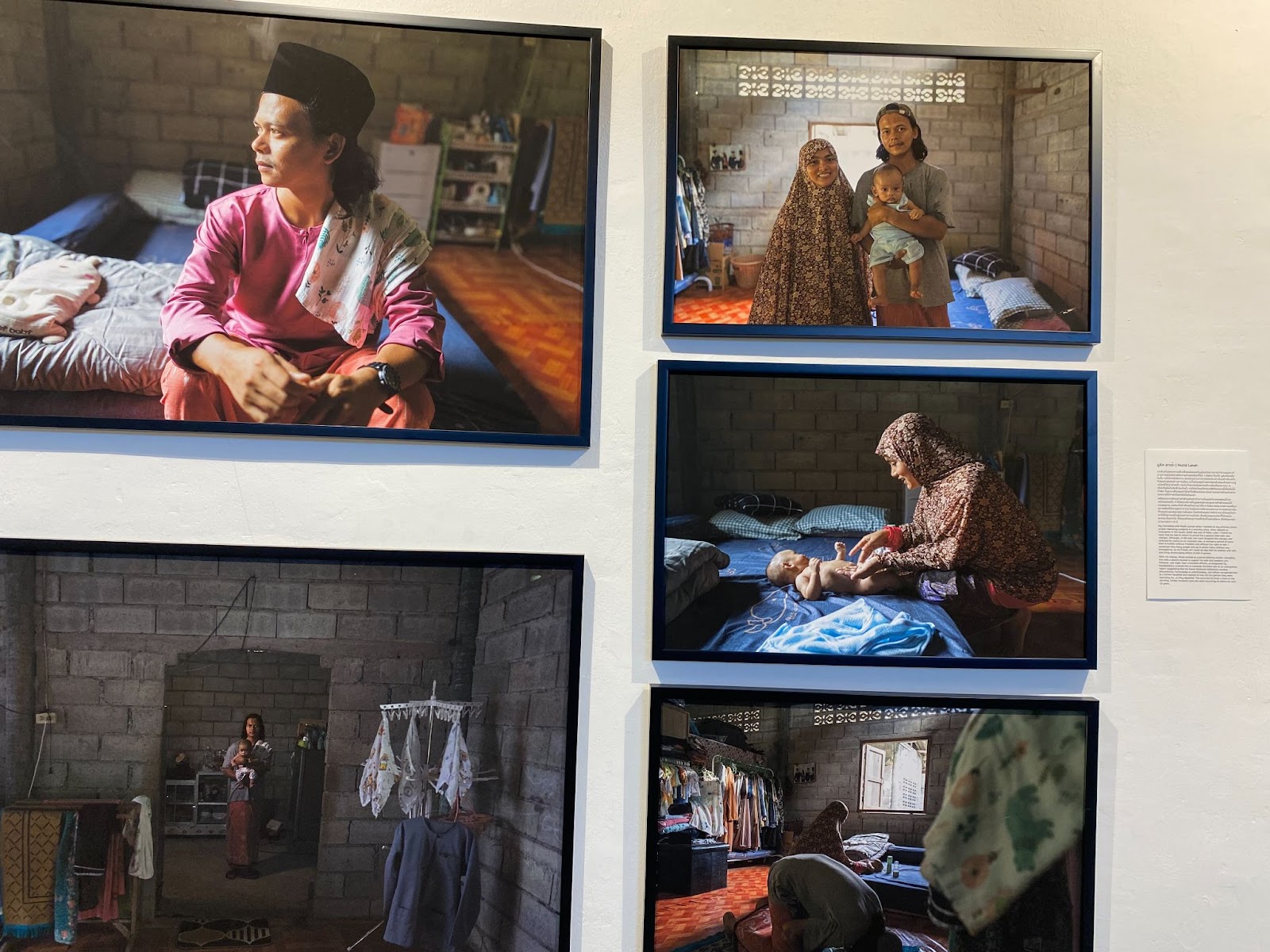
Realframe’s photos of Mulid, photo by Tara Abhasakun.

Yostorn noted that the government has made people “desperate,” since when they try to fight for their rights using the law, they are fighting “an unjust system.” He said that this is why people turn toward groups like the BRN.

When asked if he believed that art could fight stereotypes in a way that political discussions cannot, Yostorn said, “Yes, definitely, otherwise I would not be doing this. I think that if I choose the right topic, then it can reduce stereotypes. And it will speak to people with various opinions.”

Yostorn said that most people who have discussed his exhibition with him say that it allowed them to see the other side of people living in the Deep South. They say they have seen the side of the region different from the violence shown in the news. Yostorn added that his photos, together with the captions, made people understand the reality of the area, and see more of the humanity of the people living in it.

People Choosing Peace: Yostorn Triyos – The photographer promoting peace in South Thailand

0
Yostorn Triyos, photo by Realframe.
A Bangkok photographer is using his work to promote peace and challenge stereotypes in Thailand’s ‘Deep South.’

Yostorn Triyos is the co-founder and director of the photography platform Realframe. He has now worked on numerous projects centered around political and social justice issues in Thailand. His photos have explored protests calling for democracy in Thailand, the rights of ethnic minorities and laborers, and environmental issues. For the past six years, Yostorn has taken photos centering around peace in Thailand’s ‘Deep South’, a region of Muslim-majority provinces which have experienced separatist violence. In the past few months, he has been involved in two major projects on this topic, including a training session for youth, and an exhibition in Bangkok that challenges stereotypes about the region. 

Yostorn didn’t always know he wanted to be a photographer. The 40 year old entered the profession over 15 years ago after working as a campaign officer for an NGO and taking photos of migrants.

“Through photos, I was able to convey the message I was trying to convey,” he told Peace News Network over a video chat.

In August, Yostorn led a training session for youth in the region to do photography about peace. The training, sponsored by Minority Rights Group International, allowed youth ages 18 to 30 to submit their photography portfolios, before participating in a four-day camp. 

This Week in Peace #5: October 20

0
Former Finnish President and accomplished peace negotiator Martti Ahtisaari, who sadly passed away this week at the age of 86. Image credit: Joi Ito

Welcome back to This Week in Peace, our weekly roundup of global peacebuilding. 

This week, we continue to cover events in Israel and Palestine, and the very real need for peace in the region as the danger of escalation remains. We also discuss the passing of Martti Ahtisaari, a former President of Finland and a notable participant in numerous peace processes. Finally, we cover continued efforts to end the war in Ukraine and the civil conflict in Colombia. 

Israel-Palestine

Israel’s war against Hamas in Gaza continues, following last week’s terrorist attacks. The Israeli siege of Gaza, and continued airstrikes, have led to a humanitarian crisis in the small, densely populated territory. Gaza’s medical facilities are under immense stress, and many face shortages of water, food, and power due to the Israeli blockade. Following a visit to Israel by U.S. President Joe Biden, a deal was reached to allow a small amount of aid through the Rafah border crossing. An Israeli ground invasion of Gaza appears imminent, and this agreement will not end the humanitarian crisis within Gaza. However, it is a positive development that can improve the situation for many Palestinian civilians on the ground, and a promising sign that future negotiations may be effective. 

There is a desperate need for peace in the region, as fears grow of a potential escalation of the conflict. Following a blast at a Gaza hospital, a planned summit between Biden, the King of Jordan, and the Presidents of Egypt and the Palestinian Authority was canceled. For the conflict to end without further loss of life, peace talks are essential, and all sides must take risks for peace, following the example of past successful peace processes. In an encouraging sign for peace, relatives of those murdered and kidnapped in Hamas attacks on kibbutzim and a music festival called for peace. Despite the loss of their family and friends, and their own experiences during the horrific attacks, they have cautioned against seeking a purely military solution to the conflict. 

You can read our past stories covering peacebuilding in this region here, and keep an eye out for future articles on this subject. 

Remembering Martti Ahtisaari

Former Finnish President, and the 2008 Nobel Peace Prize laureate, Martti Ahtisaari, sadly passed away this week at the age of 86. Ahtisaari was a key player in negotiations that led to Namibian independence from apartheid-era South Africa, ending a long and destructive conflict. He was also a key player in supporting the Good Friday Agreemnt, and ending the Irish Republican Army (IRA)’s violent insurgency in Northern Ireland. Elected President of Finland in 1994, he remained an advocate for peace, helping to end fighting in the Balkans and in Aceh. In a time of increasing global tensions and seemingly constant conflict, people like Mr. Ahtisaari, who never stopped fighting for peace, are needed more than ever. 

Zelensky Continues to Press “Peace Formula” 

The Russian invasion of Ukraine continues, with no end to the fighting in sight. Ukrainian President Volodymyr Zelensky continues to work towards an agreement on his proposed “peace formula”, a 10-point plan to end the conflict. This week, Zelensky’s office confirmed plans to host a third conference of relevant officials from Ukraine and its allies. Russian airstrikes continue to hit Ukraine, and peace remains a distant prospect. However, the willingness of Zelensky to at least publicly work for peace is significant, considering the high death toll caused by Russia’s invasion. 

You can read more of our coverage of Ukraine here, and we will continue to cover further developments as they happen. 

Switzerland join Colombian Peace Talks 

Switzerland recently announced that it was joining Norway, Venezuela, and Ireland as a guarantor country in the recent peace talks between Colombia and a group of FARC dissidents known as the Estado Mayor Centro (EMC). These talks, which Peace News has covered both in past articles and in previous editions of This Week in Peace, have been accompanied by a ceasefire and are an important step towards ending Colombia’s decades-long civil conflict. Switzerland has previously mediated other peace talks in Colombia, and this move is a positive sign that both sides are positively approaching these talks and are invested in their success. Colombian President Gustavo Petro has pursued a “total peace” agenda, which focuses on dialogue with all armed groups present in the country. There is growing optimism in Colombia that this strategy could lead to a new era of peace, and these talks and the accompanying ceasefire will be crucial. 

For more information on Petro’s “total peace” agenda, read our recent story on the subject. You can also read more of our stories on Colombia here
Each month, Peace News publishes a monthly newsletter which summarizes all of our stories from the past month. Subscribe using the link above to stay up to date on all our stories about people working to build peace around the world.

Narges Mohammadi: A Fearless Voice for Peace

0
Protestors in London call for the release of women held as political prisoners in Iran. Image credit: Garry Knight

On October 6, 2023, Narges Mohammadi was awarded the Nobel Peace Prize. Mohammadi is a longtime advocate for the rights of women in Iran. She is currently imprisoned with many other political prisoners in Tehran’s Evin prison, which is notorious for its poor treatment of detainees. Originally an engineer, Mohammadi has advocated for the human rights of Iranians, especially women, for decades. She works with the Defenders of Human Rights Center in Tehran, which was founded by Shirin Ebadi, the 2003 Nobel Peace Prize laureate. 

Because of her work, Mahammadi has been arrested and imprisoned multiple times, spending over a decade either in prison or facing legal threats, yet has continued to fight for her rights and those of her fellow citizens. In prison, she has faced torture and solitary confinement and is restricted in the amount of time she can speak with her family. Mohammadi faces a ten-year sentence, and the Nobel Peace Prize is unlikely to change the position of  the government, which criticized the award being given to a “criminal”.  

The Iranian regime has a long history of mistreating political dissent and violating the rights of its citizens. Women in Iran face constant repression and discrimination, with strict laws regarding the wearing of the hijab. In 2022, protests broke out around Iran following the death of Mahsa Amini in police custody, after the morality police arrested her for alleged violations of the hijab law. Months of extraordinary protests, many led by women, followed. The regime responded with violence and further repression. Protesters were arrested, beaten, shot, and accused of being foreign agents. Even in the face of such immense pressure, protestors continued to peacefully advocate for their rights. Inspiring images of peaceful demonstrations show that Mohammadi’s advocacy over many decades was part of a much wider movement.

Mohammadi’s recognition as the recipient of the Nobel Peace Prize ensures that the memory of Amini and the spirit of the protest movements in Iran will remain a global cause. Despite her imprisonment, she continues to advocate for her beliefs and the rights of her fellow Iranians.  A recently released recording seemed to show her leading fellow prisoners in chants of “Woman, Life, Freedom”, one of the defining slogans of the 2022 protests. 

Mohammadi’s resilience is inspiring, as is her dedication to fight for what is right despite the abuses her own government has committed against her. Many notable global figures applauded the decision of the Nobel Committee, including French President Emanuel Macron, UN Secretary General António Guterres, and Belarussian pro-democracy activist Sviatlana Tsikhanouskaya

Past recipients also came out in support of Mohammadi, including Muhammad Yunus and Oleksandra Matviichuk, one of the 2022 laureates who drew a connection to her own activism in Ukraine. Former U.S. President Barack Obama praised Mohammadi’s “courage, and the hope that she represents—not only for the women in Iran, but for women fighting repression and violence around the world.” Malala Yousafzai, the 2014 laureate who faced threats to her life for advocating for women’s rights in Pakistan, said Mohammadi is a “courageous defender of Iranian women” and called to “celebrate the resilience and strength of women and girls, in Iran and worldwide”. Mohammadi’s husband dedicated the award to all Iranian women on her behalf from Paris, where he lives with their two children. Despite the separation from her family, mistreatment in prison and the numerous institutional obstacles she faces, Mohammadi is committed to fighting for peace for the women of Iran, and she is not alone. 

If you want to read more of our coverage of peacebuilding around the world, you can sign up for our monthly newsletter here, which will keep you updated on the stories we publish each month.

This Week in Peace #4: October 13

0
The Gaza Strip, the site of a renewed conflict between Israel and Hamas

Welcome back to the newest edition of This Week in Peace. Today is October 13, 2023, join us as we look back at the major developments in peacebuilding over the last week. 

This week, global attention has bene focused on a recent outbreak of violence between Israel and Hamas, which threatens peace in the region and puts civilians at risk. The new war threatens peace talks between Israel and Saudi Arabia, and has the potential to escalate even further. In other parts of the world, however, there have been positive signs for peace. China and India agreed to maintain peace despite an ongoing border dispute, and Colombia finally began peace talks with a rebel group, and Taiwan’s president emphasized the importance of  peaceful coexistence with China. 

Peace is Shattered in Israel and Gaza

The recent outbreak of fighting in Israel and Gaza poses one of the greatest threats to peace in the Middle East in decades. The fighting began with a massive attack on Israel by Hamas fighters, during which over 1,000 Israelis, mostly civilians, were killed. In response, Israel began a relentless bombing campaign against Gaza, which has killed over 1,500 Palestinians, many of whom are also civilians. Noncombatants on both sides have suffered, with hundreds of children killed and much of Gaza lacking power, water, and access to medical facilities. 

The fighting has been devastating on both sides, with growing fears of disaster in Gaza. Hamas took over one hundred people into Gaza by Hamas as hostages, including families and the elderly. Israel’s retaliatory bombing campaign has destroyed mosques and damaged hospitals, and Israeli minister stated that the siege of Gaza, including a blockade of electricity, water, and fuel, will continue until the hostages are freed. Foreign ministers of many Arab states have called for renewed negotiations towards a two-state solution, and the conflict threatens to derail a potential peace deal between Israel and Saudi Arabia. 

Tragically, many of those killed in the initial attacks were peace activists, who had worked to support the rights of Palestinians. While the escalating violence and horrific losses on both sides may make peace seem unlikely, it is worth remembering that the 1973 Yom Kippur war, one of the deadliest chapters in the Arab-Israeli conflict, led to unprecedented and lasting peace between Egypt and Israel. As the conflict escalates, there is a desperate need for peace, and for the leaders of the region to emulate their predecessors and take risks to build peace. 

Peace News will continue to cover this issue as it develops. You can read our past stories on this topic here, and be sure to keep an eye out for further updates. 

Positive Talks between China and India

Following the most recent round of talks aimed at resolving a long-running border dispute, China and India agreed to maintain a peaceful environment around the disputed region. The two countries have a tense relationship which has worsened in the past few years. Skirmishes broke out along the border in 2020, and the talks have failed to find a permanent resolution to the dispute. However, the commitment to maintain a peaceful border, along with limited military withdrawals, is a positive development. The choice to pursue deescalation and dialogue is an important step towards building positive peace between the world’s two most populous countries, and avoiding further destructive conflict. 

Colombia and FARC dissidents officially begin talks 

Long-awaited peace talks finally began between Colombia and an armed group known as the Estado Mayor Central (EMC). The EMC is one of the largest successor groups of the Revolutionary Armed Forces of Colombia (FARC), which chose to reject a 2016 peace agreement and continued armed combat against the government. Colombian President Gustavo Petro has put “total peace” at the center of his agenda, which involves dialogue with all remaining armed groups in Colombia. The government and the EMC also agreed on a ceasefire, which is expected to last at least ten months. The ceasefire and talks are important steps to bringing the decades-long conflict in Colombia to an end, and an encouraging sign that Petro’s peace initiative may be successful in the long run. 

Peace News recently published an article featuring expert perspectives on Petro’s “total peace” agenda, which you can read here. You can read our past coverage of Colombia here, and we will continue to cover further developments.  

Taiwan’s President Calls for Peace 

Taiwanese President Tsai Ing-Wen stated that peace was the “only option” to resolve disputes between China and Taiwan. China views the island as a breakaway province, and has recently escalated its military maneuvers around it. Tsai’s Democratic Progressive Party, which supports the status quo, will face the Nationalist Party, which favors unification with China, in next year’s elections. Tsai’s public appeal for peace, despite the ongoing tension with China, is an important step towards resolving the dispute in a way that respects the wishes of the Taiwanese people. Dialogue and reconciliation are necessary to preserve cross-strait peace and prevent further military escalation. 

For more stories about global peacebuilding, you can sign up for our monthly newsletter, which highlights all our content from each month.