Home Blog Page 75

This Week in Peace #18: January 26

0
Armenian President Ilham Aliyev and Armenian Prime Minister Nikol Pashinyan, seen here with European Council President Charles Michel, have been negotiating an unprecedented peace treaty between their two nations. Image credit: Office of the Presidency of Azerbaijan

This Week in Peace #18: January 26, 2024

Welcome back to This Week in Peace, our weekly summary of events in global peacebuilding. 

As the first month of 2024 draws to a close, we bring you updates on the state of negotiations to end the war in Ukraine and Gaza, and progress towards a peace treaty between Armenia and Azerbaijan. 

This series is also offered a weekly newsletter. You can sign up here to get future editions sent to you directly every week, and stay up to date on peacebuilding around the world. 

Ukrainians balance peace and justice

This week saw the 700th day of fighting in Russia’s invasion of Ukraine (although some date the start of the war to the 2014 annexation of Crimea), with no end in sight. Russia’s occupation of a significant amount of Ukrainian territory, and its desire to retain it and have it be legitimized in any postwar settlement, has been the major issue preventing peace agreements. Russia recently rejected Switzerland’s offer to host a peace summit, reiterating Russian demands including enforced Ukrainian neutrality as a condition for a peace settlement. Oleksandra Matviichuk, a Nobel Peace prize winner in 2022, recently spoke on what peace means to her. She, along with the vast majority of Ukrainians, rejects giving up territory to end the war, citing Russian abuses in occupied Ukraine. Civilians continue to suffer amid ongoing Russian missile and drone attacks, and an end to the war is needed to prevent further violence. However, any eventual peace deal must be just for the people of Ukraine, and not legitimize Russia’s illegal invasion of their territory. As Matviichuk said, an end to the fighting that rewards the invasion and occupation, or that prevents Ukraine’s ability to determine its own international alliances, would not be a true peace deal. Unfortunately, the current Russian regime is highly unlikely to agree to such terms, leaving few options for a just peace. 

For more stories about Ukraine, click here. We will continue to cover this conflict and efforts to find a just peace. 

Politics block a ceasefire in Gaza

Israel and Hamas remain far apart on the proposed terms of a ceasefire in Gaza, with political leaders on both sides prioritizing their own interests instead of the needs of civilians. Both sides rejected deals proposed by the other this week which would have stopped the fighting, at least temporarily. Consensus on the post-war status of the territory, and the length of a ceasefire, is proving difficult to find. Israeli Prime Minister Benjamin Netanyahu, whose government relies on far-right extremist politicians, refuses to consider a sovereign Palestinian state, a role for the Palestinian Authority in Gaza, or an end to the war that leaves Hamas in power in Gaza. Hamas, whose leadership is largely based in Qatar, refuses to relinquish its control over Gaza or release any hostages without a complete ceasefire. Israel is proposing a short-term ceasefire in exchange for the release of all hostages, while Hamas rejects anything less than a permanent end to the fighting. At the moment, the two sides appear unwilling to compromise, despite the clear need for an end to violence in Gaza. 

As both sides prioritize their political goals and image at the cost of prolonging the war, Palestinian civilians continue to suffer the consequences. Over 25,000, most of whom are women and children, have been killed by the Israeli campaign, likely including some of the hostages. An end to the fighting woud allow more humanitarian aid to enter Gaza, restore security for civilians, and allow the decimated health and social systems in the strip to recover. The US, which has hoped to use a deal between Israel and Saudi Arabia as a vehicle for an end to the war, continues to attempt to play a mediating role. This is complicated by Netanyahu’s hardline rhetoric and distrust from the Palestinian side. The US dispatched CIA director William Burns, a veteran diplomat, to help negotiate a deal between the two sides. Diplomatic engagement by the US and other regional actors, including Egypt and Qatar, has seen some success in the past, and hopefully can help push both sides to agree to a ceasefire soon. 

You can read our past articles on the Israeli-Palestinian conflict here.

Armenia and Azerbaijan 

Armenia and Azerbaijan continue to work towards a historic peace agreement, defying expectations of renewed conflict between the two neighbors. For years, the status of the disputed region of Nagorno-Karabakh had caused tensions and several military conflicts between the two states. Last year, Azerbaijan invaded and swiftly occupied the territory, leading to an exodus of ethnic Armenians. Defying expectations of further conflict, the two sides have been engaged in negotiations to sign a peace treaty and resolve their territorial disputes. The two sides remain far apart on some crucial issues, and progress has not been as fast as outside observers had hoped. However, the fact that a treaty is being discussed at all is a major step forward, considering the very real possibility of full-scale war between the two neighbors last year.

Click here to read our past stories on Armenia and Azerbaijan, and here to read our story on the events in Nagorno-Karabakh last year. 

Sudan’s stealth conflict means its people are suffering in silence

0
Darfur, Sudan. Image credit: UN Photo/Fred Noy

While the world is largely focused on conflicts in Gaza and Ukraine, a civil war in Sudan has caused a humanitarian crisis, with thousands killed and millions displaced. The Sudanese Armed Forces (SAF) and the Paramilitary Rapid Support Forces (RSF) are fighting for control of the country, driven by a rivalry between the group’s respective leaders, General Abdel Fattah al-Burhan and Mohamed Hamdan Dagalo, also known as Hemedti. The two men are former collaborators who overthrew longtime dictator Omar al-Bashir in a 2019 coup, a few months before protestors were massacred in Khartoum by the RSF. In 2021, a transitional civil-military government was overthrown in another coup, carried out once again by the SAF and the RSF. Tensions between the two organizations, who control significant portions of Sudan’s economy and natural resources, erupted into open war on April 15, 2023

The civil war has led to a dire humanitarian situation, with both sides accused of war crimes. Civilians have been caught in the crossfire and deliberately targeted, in addition to the widespread use of sexual violence. To date, it is estimated that over 7 million people have been displaced and 12,000 killed. One particular area of concern is the Darfur region, where largely Arab militias known as the Janjaweed carried out ethnic cleansing and crimes against humanity against non-Arab ethnic groups, especially the Masalit people, in the early 2000s. The RSF is the organizational successor of the Janjaweed, and now controls most of Darfur, where it appears to be carrying out ethnically-motivated atrocities once again. The capital city of Khartoum remains split between the two sides, as the fierce fighting of last spring has settled into a stalemate.The RSF now controls key infrastructure, and the SAF government was forced to relocate to Port Sudan. The RSF has made recent advances, capturing the strategically important city of Wad Manani in December. Thousands of refugees, many of whom may have already fled earlier fighting in Khartoum, were forced to leave. Many Sudanese fear that an RSF victory, or at least an expansion of its territory, will bring more of the looting, sexual violence, and deliberate targeting of civilians already seen in Khartoum and Darfur. 

The nature of the conflict makes a simple media framing difficult – both sides are guilty of war crimes, and worked together to overthrow a civilian government. Neither side is working to protect civilians or working towards civilian rule. Any resolution to the conflict will almost certainly result in one or both retaining their power and wealth. Millions of Sudanese have suffered due to this power struggle. Dagalo has been attempting to appeal to a broad audience by meeting with heads of state and presenting the RSF as an anti-Islamist force in Sudan. He has also called for an immediate ceasefire if the SAF also agreed. Dagalo’s past, as the head of an Islamist dictator’s notoriously brutal paramilitary force, and a prominent coup leader, makes him an unreliable partner for peace. Burhan rejected earlier calls for a ceasefire, saying that the “war crimes and crimes against humanity” the RSF has carried out in Darfur make negotiating impossible. However, Burhan’s forces have been accused of similar behavior, and the SAF has rejected a past proposal by a Kenya-led regional grouping which involved a foreign peacekeeping force. Neither leader is a credible advocate for the rights of the Sudanese people, and appear to weaponise the language of peace to gain more power for themselves.

As the crisis continues, Sudan faces a pessimistic outlook. There are a number of factors that have led to such a highly destructive war receiving little press coverage in much of the world. Two high-profile wars, in Ukraine and then Gaza, have consumed much of the world’s attention, when it comes to international news, leaving less time and space for Sudan. The war in Gaza, especially, with the horrific civilian death toll in the strip and the massacre carried by Hamas, have captured global interest and remain prominent, especially in Western and Arab countries where the Israeli-Palestinian conflict is an important political issue. While international attention is focused elsewhere, potential partners for peacebuilding, including Sudan’s neighbors, other regional powers, and countries like the United States and Russia, have either failed to sufficiently motivate both sides to meet for peace talks, or picked a side to promote their own interests. 

Sudan’s direct neighbors have little inclination to press for peace and a restoration of democracy. Egypt and Chad are both ruled by military regimes, while South Sudan faces ongoing political turmoil following its recent independence from Sudan. Libya and the Central African Republic are dealing with civil armed conflict, while  Ethiopia is still dealing with the fallout from a long and brutal civil war of its own in the Tigray region. Eritrea, which took part in the Tigray war, is one of the world’s most militarized and repressive dictatorships. Sudan is part of what has been called Africa’s “coup belt”, where military takeovers have been common in recent years, and international pressure has failed to preserve democracy throughout the region, partially due to the declining leverage of Western powers in Africa. 

The most significant effort to build peace since the war began in April 2023, took place in Jeddah, Saudi Arabia, in October 2023, led by the “Quad”, consisting of the US, UK, Saudi Arabia, and the UAE. One factor complicating their work, however, is that most international actors to date appear to be focused on  picking sides to gain influence in Sudan.The UAE, despite its role in peace talks, has been accused of covertly arming and supporting the RSF. Sudan is another example of Russia’s use of the Wagner Group and other PMCs to back autocrats and military regimes in order to access lucrative resources and cultivate influence in Africa. Egypt has armed the SAF with Turkish drones, and Ukraine has attacked Wagner-linked forces in Sudan on at least one occasion. Further complicating the international situation is the fact that the United States and European Union will hold elections this year that could impact future foreign policy decisions and further distract media and public attention from international news. In a further blow, the United Nations recently removed its political mission in Sudan, removing a credible peace intermediary and prominent international presence. In order for a peaceful resolution to be found, Sudanese elites and their international backers must be willing to consider compromise. If they continue to refuse to negotiate, the Sudanese people will continue to pay the price. 

This Week in Peace #17: January 19

0
Ukrainian President Volodymyr Zelenskyy, seen here in 2020 at the World Economic Forum in Davos, Switzerland, recently presented a peace plan to end the war in Ukraine. Image credit: World Economic Forum / Boris Baldinger

Welcome back to This Week in Peace, our weekly summary of events in global peacebuilding. 

This week, we discuss the differences between Ukrainian and Russian peace proposals, a small diplomatic victory in Gaza, and continued progress towards peace in Colombia. 

This series is also offered a weekly newsletter. You can sign up here to get future editions sent to you directly every week, and stay up to date on peacebuilding around the world. 

Competing, incompatible visions for peace in Ukraine

At the World Economic Forum in Davos, Switzerland, Ukrainian President Volodymyr Zelenskyy presented a peace plan to end the war between his country and Russia. The plan calls for Russia to withdraw from all occupied territory, along with provisions for reparations and accountability for war crimes committed by Russian forces. The static military situation, and Russian President Vladimir Putin’s likely unwillingness to relinquish occupied territory, especially Crimea, make acceptance of the plan highly unlikely. However, Switzerland has agreed to host talks on it, and while those will not include Russia they could help to find a negotiated solution acceptable to both sides. The Kremlin has recently indicated that it may be open to a ceasefire, if it legitimizes Russia’s occupation and annexation of Ukrainian territory, which Kyiv has repeatedly rejected. As Ukrainians continue to suffer from ongoing Russian aerial bombardments, and military casualties on both sides remain high, peace is desperately needed. However, any peace should be a just peace for the people of Ukraine, instead of rewarding the aggression behind Russia’s invasion. 

For more stories about Ukraine, click here. We will continue to cover this conflict, and efforts to resolve it peacefully. 

Diplomacy finds a (small) breakthrough in Gaza

Despite international activism and continued high-level diplomacy, there is no sign of progress towards a ceasefire in Gaza. However, this week saw a small diplomatic victory. France and Qatar were able to broker a deal to increase aid to Gaza. Israeli hostages still held by Hamas will have access to medicine, while Israel will allow more humanitarian aid into Gaza amid its ongoing military operation there. Gaza has been left devastated by the 100 day Israeli War following the October 7th attacks, with millions of Palestinian civilians displaced, over 20,000 killed and tens of thousands more wounded. International pressure continues to grow on Israel to scale back, pause, or end its attacks, which has so far failed to have an impact. An end, however, brief, to the fighting is needed to protect Palestinian civilians in Gaza, and a permanent two-state solution is necessary to prevent future conflicts, and allow a future peaceful coexistence for both peoples. 

You can read our past articles on the Israeli-Palestinian conflict here.

Colombia continues working for peace

Colombia’s government announced the extension of a ceasefire with a major FARC splinter group until July, as talks continue in Bogota. Colombia’s President, Gustavo Petro, has made peace talks with all armed groups remaining in Colombia a major part of this “total peace” strategy, but it has failed to reduce violence in rural areas in Colombia. The extended deal includes provisions to stop the armed group from attacking civilians, which had continued during the previous 3-month ceasefire. While there is no guarantee that the ceasefire will last beyond its expiration, it is still a positive step in the Colombian peace process, part of a slow trend towards peace since the 2016 peace deal with FARC. 


Click here to read our past coverage of peacebuilding in Colombia, and our story on the “Total Peace” initiative.

Women Building Peace, Prosperity, and Gender Equality Amidst Bangladesh’s Rohingya Migration

0
A woman homestead gardening with the Livelihoods Project, photo by Maiya School.

Following brutal violence against Myanmar’s Rohingya population, almost a million members of the persecuted minority group now live in Cox’s Bazar, Bangladesh. The most recent wave of Rohingyas arrived in August 2017, after Myanmar’s military launched a deadly counter-insurgency and ethnic cleansing campaign against the Rohingyas. 

The migration of Rohingyas to Bangladesh has brought with it some economic challenges. According to the Tricontinental Centre (CETRI), a Belgian NGO, supporting Rohingya refugees costs Bangladesh  an estimated $1.21 billion a year. In recent years, due to the Covid-19 pandemic, as well as several other crises around the world, international humanitarian aid for Rohingyas has been shrinking. Anas Ansar, a Bangladeshi PhD researcher at Germany’s Bonn Center for Dependency and Slavery Studies, told Peace News Network that humanitarian aid and security are both pressing concerns at the moment. 

“The grave concerns at this moment are the reduction in humanitarian relief operations, reductions in global funding, and disappearing interest by the international community regarding the Rohingya plight,” Ansar said.

When the Rohingya refugees began to arrive in 2017, they were welcomed by many in Bangladesh. Since then, the “sentiment has shifted,” and they face an environment that has become less welcoming in recent years. But some women’s initiatives in Cox’s Bazar are working to build peace, livelihoods, and gender equality. One girls school, Maiya School, is working with local organizations to empower Bangladeshi women to build their own livelihoods, in order to cope with price hikes. The school is also working towards gender equality by teaching girls advocacy skills, and hiring both Bangladeshi and Rohingya staff. 

The Australian-run school educates 80 Rohingya girls. It opened in April 2022 in the Katupalong refugee camp, and aims to help displaced girls obtain an education in order to uplift their communities. Maiya seeks to fill a gap in girl’s education in the refugee camps, particularly as girls in these camps are often vulnerable to child marriage and gender-based violence (GBV). The school has a security fence around it so that students won’t be harassed by men and boys, and all of the school’s teachers are women. The school provides Rohingya girls with a safe environment to learn, and clean facilities, while focusing on female empowerment. 

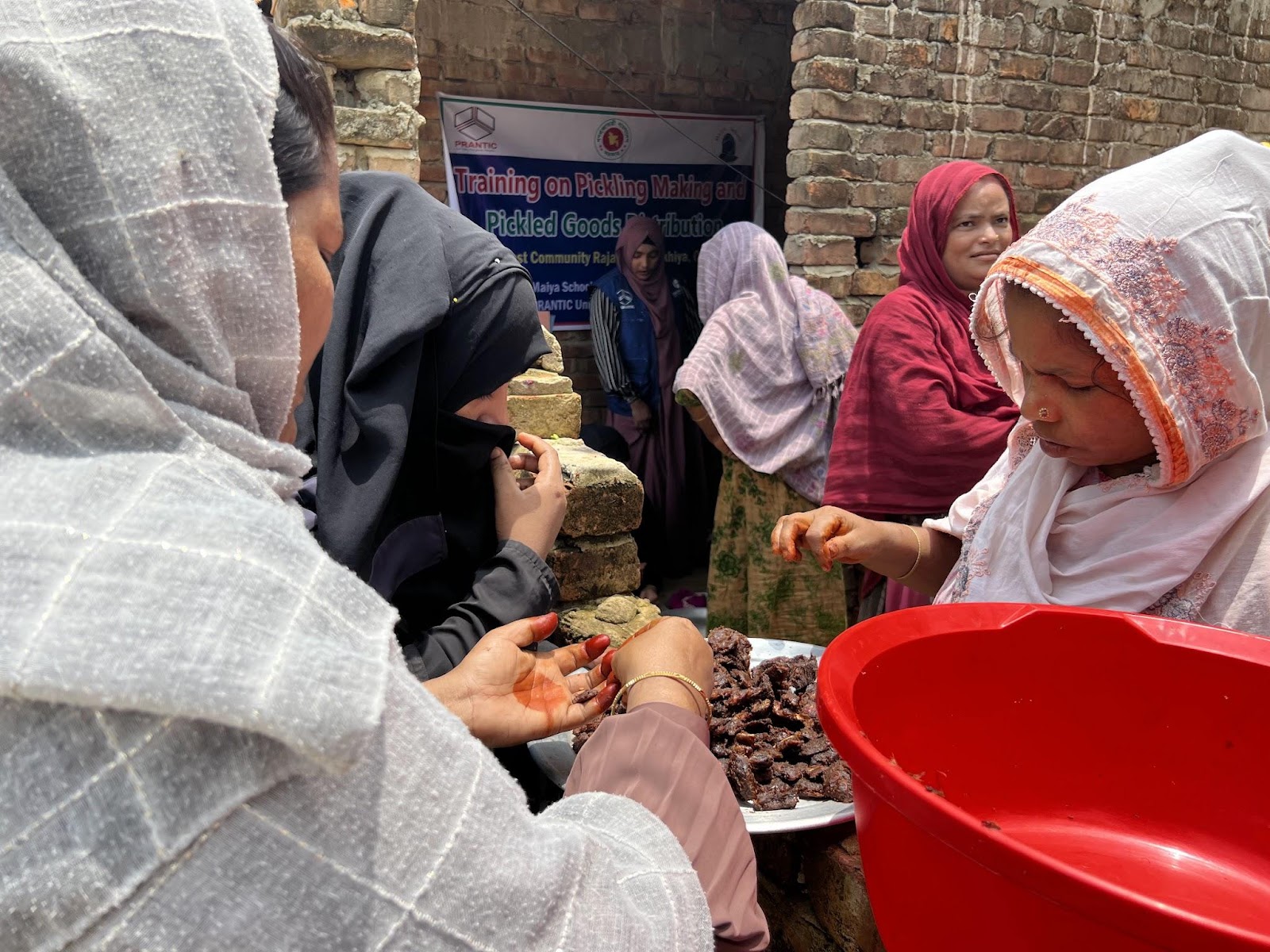
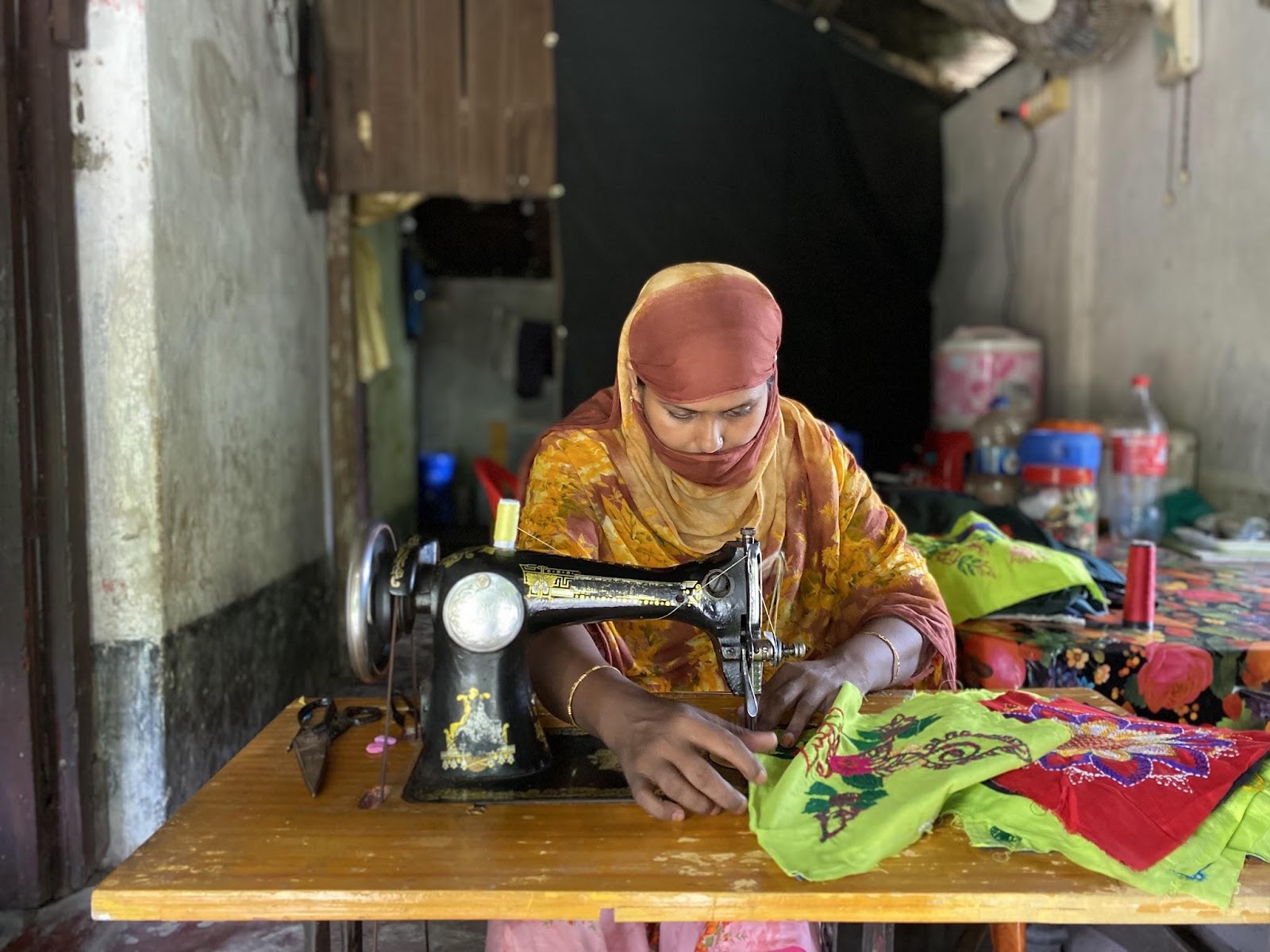
But the school isn’t only helping Rohingyas. In order to help women in the host community cope with rising costs, Maiya is working on a livelihoods project. In May 2023, the school began partnering with two Bangladeshi women’s organizations, Hilfull and Mamota, as part of the Women’s Livelihood Project. The project teaches 40 Bangladeshi women in the Ukhiya sub-district homestead gardening, compost training, pickling, and sewing.  These skills help the women earn more income as prices in the area rise. This has helped to build better relations between Bangladeshis and Rohingyas.

Women make pickled products with the Livelihoods Project, photo by Maiya School.

“In the past, onions were about 25 to 30 taka [per kilogram], now it’s about 250 taka. Vegetables were about 25 taka [per kilogram], now they are about 80 taka,” Khaleda Begum, a member of Hilfull, told Peace News Network.

Begum said that Rohingyas receive more aid than Bangladeshi host communities. She noted that Rohingyas might receive helpful tools such as sewing machines, but Bangladeshis don’t. When asked if this had caused anger among Bangladeshis, Begum said that it had.

“Other organizations are working with the Rohingya community, if they also work with host communities, it will be perfect,” she said.

Women involved in the project sell their products, such as embroidered handicrafts and pickled goods. The women sometimes struggle to find enough outlets to sell their goods, Begum added. She said that she was able to sell some products at a fair an hour away in a larger city, but these kinds of fairs don’t happen often. Still, Begum said the Livelihoods Project has helped Bangladeshis to become less angry at Rohingyas, since Bangladeshis are getting some support. 

A woman involved in the Livelihoods Project embroiders, photo by Maiya School.

Maiya School also builds relations between the refugees and host community by hiring both Bangladeshi and Rohingya staff, who work side-by-side. Half of the staff working within the camp are Bangladeshi, and half are Rohingyas, said Philippa Nilsson, the school’s co-founder and director.  Nilsson said the school has a Rohingya teacher who teaches Burmese language, and a teacher from the Bangladeshi host community who teaches English. She said the management team above them is a “mixed team.”

“They work really well together, and have different skills and different knowledge and context as well,” she told Peace News Network. 

In addition to bringing the communities together to collaborate in their work, Nilsson said that the Rohingya Education Project and the Livelihoods project are helping to build peace by providing resources and training to both communities. She said that the Bangladeshi workers know the Rohingya community very well, and work well with them. 

 “I believe that that is working towards peace and reconciliation overall by equipping our girls with advocacy skills, and really empowering them with an education so that in the future they can advocate for themselves to their community, to the global community, and they can actually advocate for their human rights.”

Nilsson added that the school provides girls with life skills training about how people interact in society, and how to be active in society. The school also has a youth advisory panel consisting of 10 girls who meet every couple of months to discuss issues that impact them. 

“Even by just providing a space where girls can safely meet and talk about issues that are important to them and try and come up with solutions, that is really unique and important for them to feel empowered and be able to advocate for themselves in the future,” Nilsson said.

The school follows Myanmar’s curriculum, so that the girls will be prepared with the same education as other Burmese citizens if they return to Myanmar.

This Week in Peace #16: January 12

0
The Red Sea, where Houthi attacks against commercial shipping have complicated ongoing peace negotiations with Saudi Arabia. Image credit: Claudio Nichele

Welcome back to This Week in Peace, our weekly summary of events in global peacebuilding. 

This week, we discuss international efforts to broker peace in Gaza, a complicated situation for peace in Yemen, and a blow to hopes for a ceasefire in Sudan. 

This series is also offered a weekly newsletter. You can sign up here to get future editions sent to you directly every week, and stay up to date on peacebuilding around the world. 

Blinken’s peace tour unlikely to see a breakthrough

US Secretary of State Antony Blinken has been in the Middle East this week, in what will likely prove a futile effort to find consensus for peace. The EU’s top diplomat, Josep Borrel, was also in the region this week. The US, Israel’s main international backer, continues to push the government of Israeli Prime Minister Benjamin Netanyahu to make progress on a two-state solution, with a path to an independent Palestinian state that would control post-war Gaza. The US still hopes to broker a peace and normalization agreement between Israel and Saudi Arabia, but peace in Gaza and progress towards a Palestinian state are necessary for Saudi Arabia to be able to consider such a deal. Blinken’s efforts are unlikely to convince many of the most influential figures in the conflict. Hezbollah’s leader threatened escalation with Israel as long as the war continues, and said that he was unwilling to discuss peace until the fighting in Gaza stops. Netanyahu, who depends on support from far-right politicians who oppose Palestinian self-determination, has been vocal about his opposition to an independent Palestinian state. For the people of Gaza, the need for peace is far more urgent than any political issues. 

You can read our past articles on the Israeli-Palestinian conflict here, as well as our recent video on peacebuilders working in Israel and the West Bank. 

A complicated outlook for peace in Yemen

The crisis in the Red Sea continued to escalate this week, as Yemen’s Houthi rebels continued their attacks on merchant vessels. Since the start of the conflict in Gaza, the Houthis have attacked shipping heading into the Red Sea, claiming they only target Israeli-owned vessels or those heading to Israel. The Iran-backed group has also launched increasingly frequent attacks against American and British warships in the region. While the coalition of mostly Western naval ships intended to protect commercial shipping has so far restrained from offensive action, continued attacks could provoke a response, which could involve Iran and lead to a wider regional conflict. Avoiding escalation is essential to maintaining regional peace, as fears persist that Israel may expand its war to Lebanon. An end to the attacks on international vessels and de-escalation is essential to preserving a path to peace with Saudi Arabia, the main adversary of the Houthis. The main Houthi negotiator claimed that their actions have not endangered the peace deal, but as international pressure grows following a UN Security Council resolution, the crisis could begin to endanger that progress. Saudi Arabia does not want the conflict to escalate again, but while the Houthis seem interested in that deal, their apparent willingness to engage in direct conflict with the United States and Israel could harm the progress towards peace. 

You can find past Peace News stories on Yemen here

Sudan’s top general rejects a ceasefire offer

Last week, we reported on an offer for an immediate ceasefire in Sudan, led by the head of the paramilitary Rapid Support Forces (RSF). The civil war between the RSF and  the Sudanese Armed Forces (SAF) continues as Sudanese civilians are caught in the crossfire. The head of the SAF, General Abdel Fattah al-Burhan, rejected that offer and said that reconciliation was impossible, pointing to “war crimes” carried out by the RSF during the monthslong conflict. Burhan’s forces have also been accused of war crimes during the war, and millions of Sudanese civilians have been displaced, with tens of thousands killed. A peaceful resolution is desperately needed to prevent further violence, as the power struggle between the two armed groups continues and concern grows over atrocities committed in the Darfur region. 

You can find our past stories on Sudan here