


Over 60% of armed conflicts reoccur; thus, peace agreements alone cannot ensure lasting peace. Youth (aged 25 or less) make up 42% of the global population and can be powerful agents of change. Young people can break these cycles of conflict by addressing the root causes and building quality peace, which goes beyond ending violence. It includes the attitudes, institutions, and structures that ensure security, dignity, and predictability for all people. Quality peace can be built even in countries without recent violent conflicts. Youth peacebuilding, in this regard, is vital to sustainable, quality peace.
There are 4 key dimensions to youth peacebuilding. First, engagement: youth need opportunities to participate in decision-making processes. Their engagement brings fresh perspectives and innovative solutions. Such participation also fosters a sense of being valued among young people. Thus, engaging youth to work towards positive change can help prevent future violent conflict.
Second, inclusive and quality education helps young people develop essential skills and knowledge for peacebuilding. Education can also change attitudes and behaviors, promoting understanding and tolerance across groups, including conflict rivals. Schools can become places where peace is taught and practiced on a daily basis.
Third, information empowers youth to understand their rights, the world around them, and how they can make a difference. Access to information also connects youth with peers and mentors, fostering a sense of global community. Internet access and free press is crucial for youth peacebuilding.
Fourth, inclusion spans the three dimensions above. Inclusive policies and practices ensure that all young people, regardless of their background, can participate in peacebuilding. When young people from diverse backgrounds come together, they can build stronger, more inclusive and resilient communities.
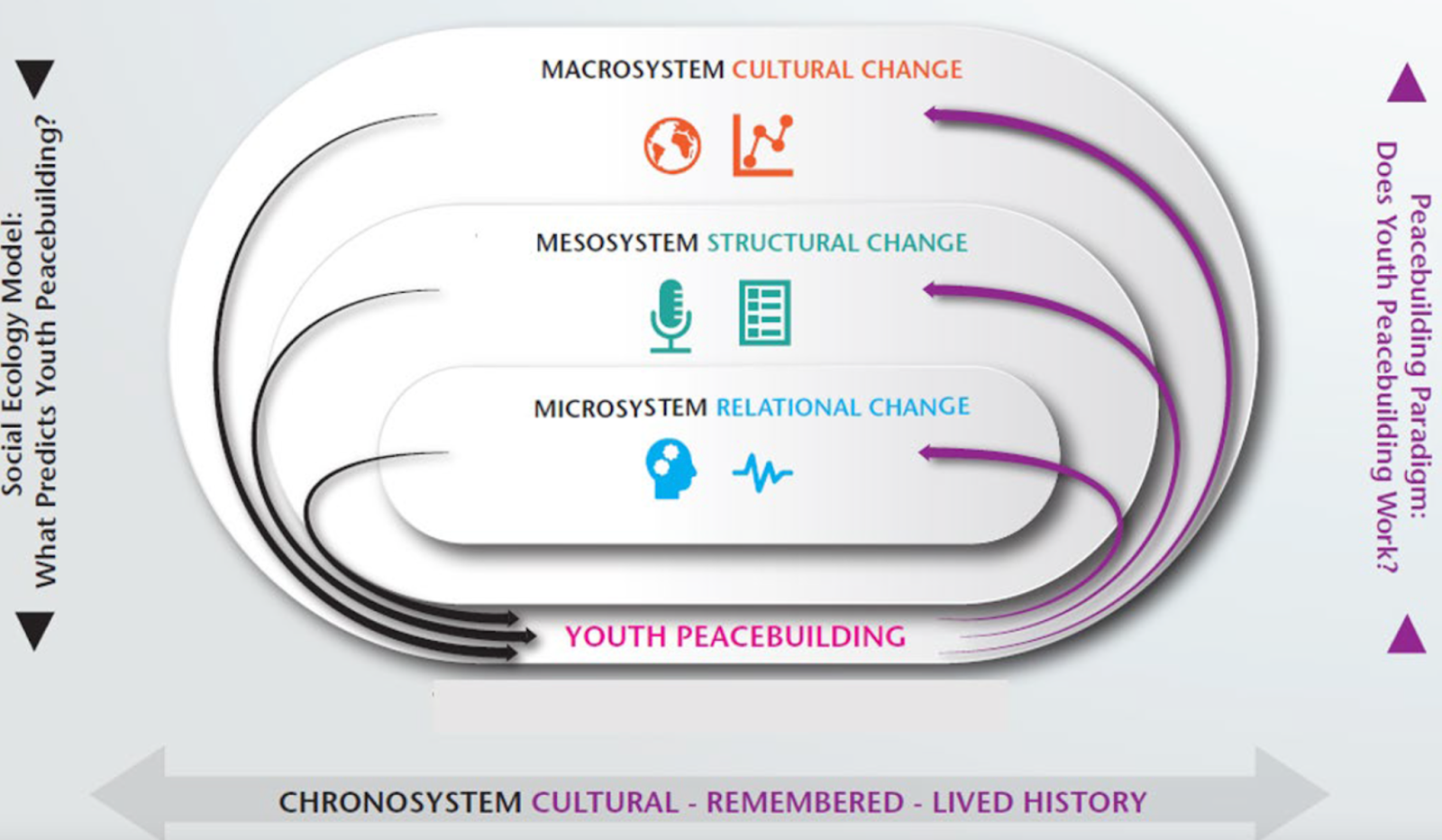
Framed by the Developmental Peacebuilding Model (Figure 1), in the Helping Kids! lab’s research, we examine the factors that shape youth peacebuilding (e.g., empathy, positive intergroup attitudes, exposure to intergroup violence). In a new line of research, we test if youth peacebuilding works.
We examined if, and how, these four dimensions of youth peacebuilding dimensions – engagement, education, information, and inclusion – influence quality peace comparing data from 165 different countries over 10 years.Education and information were key for quality peace. More specifically, education served as a pathway for indirect effects of information, engagement and inclusion. For example, when more young people went further in school, they were able to use access to a free press (i.e.information) to promote greater engagement.
This network of connections among youth peacebuilding dimensions was foundational for stronger quality peace over time. One surprising finding was that lower levels of inclusion were related to greater quality peace one year later; this finding might indicate that intergroup tensions can motivate peacebuilding. Together, each youth peacebuilding dimension was directly or indirectly linked to quality peace, both for a particular country as well as comparing between countries.
Our research directly supports the United Nation’s Youth, Peace, and Security (YPS) Agenda. In 2015, the first of three YPS resolutions was passed by the UN Security Council. Our findings reinforce these policy directions that call for youth involvement in conflict prevention, resolution, and peacebuilding efforts.
Consistent with the YPS agenda, we argue that youth are essential partners in achieving quality peace. This particular study outlines four channels through which governments, international organizations, civil society organisations can foster youth engagement and leadership in peacebuilding initiatives. Investing in engagement, education, information and inclusion among young people offers a way to build quality peace across a variety of contexts. These findings, along with previous Helping Kids! papers, suggest that the Developmental Peacebuilding Model may be a useful framework to integrate policy, research and practice, which can help to build quality peace and involve youth around the world.

Laura K. Taylor (PHD @lauraktaylorPHD) is an Associate Professor in the School of Psychology at University College Dublin and the Principal Investigator of the Helping Kids! lab (@HelpingKidsLab).She integrates developmental and social psychology with peace studies to examine positive development and social inclusion among children and youth in conflict-affected settings, such as Colombia, Croatia, Kosovo, Israel, Republic of North Macedonia, and Northern Ireland. She uses the Developmental Peacebuilding Model (Taylor, 2020) to study how multiple factors (e.g., family, school, nation) influence child development. Laura also focuses on children’s and youth’s agency, more specifically, how outgroup prosociality toward conflict rivals may be contribute to peacebuilding.